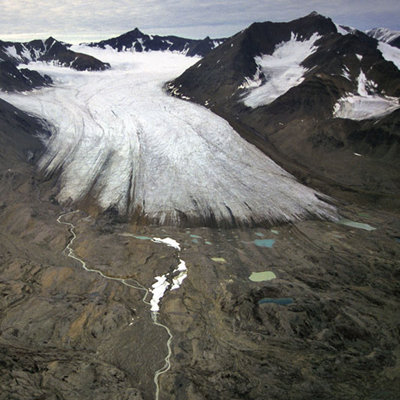
Glacier recession, the carbon cycle and microbial release
Throughout this resource the term ‘Alps’ will be used to describe the European mountain range, which covers a territory of approximately 190 700 km² and encompasses eight European countries: Austria, France, Germany, Italy, Liechtenstein, Monaco, Slovenia and Switzerland.
Thanks to Tris Irvine-Fynn (Aberystwyth University) for the constructive feedback that helped the development of this resource.
Specification
AQA 3.1.4.5 Human impacts on cold environments. Concept of environmental fragility.
3.1.1.1 Water and carbon cycles as natural systems. Inputs – outputs, energy, stores/components, flows/transfers, positive/negative feedback, and dynamic equilibrium.
Edexcel 2A.4 Mass balance is important in understanding glacial dynamics and glaciers as systems.
Area of study 3, Topic 6: The Carbon Cycle and Energy Security. 6.3 A balanced carbon cycle is important in sustaining other earth systems but is increasingly altered by human activities.
OCR 1.a. Glaciated landscapes can be viewed as systems.
Topic 1.2 How much change occurs over time in the water and carbon cycles?
WJEC A Level 1.2.1 The operation of a glacier as a system.
Section A – Global Systems. Water and Carbon Cycles. 3.1.1: Concept of system and mass balance.
The situation
Recently, melting has been observed in glacier ice bodies from the Himalaya to the Andes, with the most visible apparent recession in Europe. Many of the continent’s glaciers are now in recession due to both a warm summer and a record warm winter in 2022.
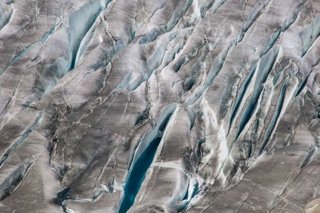
Figure 1 glacial crevasses filled with meltwater in the lower regions of the Great Aletsch Glacier
Daniel Farinotti, a glaciologist at ETH, the research university of Zurich, explains ‘in many glaciers we now see features of what we call collapse – crevasses opening up and ice falling apart – and this is certainly not going to regrow next year’ as Alpine glaciers fall victim to Europe’s warming climate.
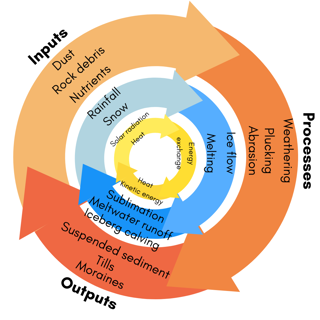
Figure 2: The glacier system Inputs, Processes, and Outputs are coloured into blue for water/ice, brown for sediments, and yellow for energy. Erosion, transportation and deposition would be along the blue/brown boundary (occurring to ice and sediment) © RGS-IBG
This resource was first published in 2023.