Mass balance and rising ELAs
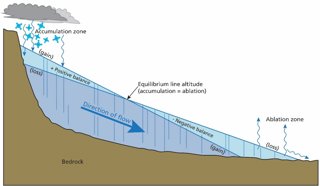
A glacier’s ELA is an acronym which stands for the equilibrium-line altitude. The ELA – the point of elevation where the annual mass of accumulation (snow input) and ablation (ice melt output) are equal – marks where the climatic mass balance is zero. Calculating the location of this line allows scientists to monitor a glacier’s mass balance, shown in Figure 7. At the end of the summer season, above the ELA is the snow-covered accumulation area and below is the bare ice glacier surface.
The glacier mass balance dictates where the ELA lies. Figure 7 illustrates glacial mass balance. There are some places across a glacier that may have positive mass balance and other places with a negative one. Over the period of a year, we can add up all these places over a glacier to determine if there is an overall positive or negative net balance. The ELA for a low-slope glacier and a steep glacier is shown in Appendix D.
Across Earth's cold regions, with the exception of Antarctica, ELAs have been rising at up to 8m per year. The upward migration of this line is an effective signal of climate change.
In places like the Alps scientists study the movement of the ELA in ‘real time’ – it is an important indicator of climate change – offering undelayed and continuous data.
Cold environments in Europe are suffering from the effects of climate change because the glaciers are either warm-based or polythermal. These glaciers are particularly susceptible to melting as European summers become warmer, longer and drier. Throughout the twentieth century this has manifested in declining ice volumes across the mountain range, with a loss of 2 Gt of glacier ice per year since 1961.
Rising atmospheric temperatures are causing more and more glaciers to recede. Currently there are 4395 glaciers still present in the Alps with a total area of 1806km2 of ice and snow. Between 1901 and 2000, the mean ELA rose by 114m mainly due to an increase of 0.8°C in summer temperature.
Over the next century, glacier ELAs are expected to continue to rise in altitude with a significant loss in volume of glacier ice. Appendix A shows the measurements for ELAs in Europe from 2012 to 2022. Across the European Alps many valley glaciers are expected to disappear completely by 2100, regardless of which emission scenario is used (Representative Concentration Pathways (RCP) 2.6, 4.5, 6.0 or 8.5).
The reason for the continued rise in glacial ELAs and the loss of ice is due to the continued atmospheric warming and the consequent down-wasting or thinning of glacier ice, and ultimately the disintegration or disappearance of the glacier. As a result, most alpine glaciers are now described as ‘in disequilibrium with current climate’.
Figure 7 Diagram of a valley glacier system indicating accumulation, ablation and the equilibrium line © Trista Thornberry-Ehrlich (Colorado State University) National Park Service