Types of glacier
There are many types of glacier, and the size or setting of a glacier often defines the type. These types include: ice sheets, ice caps, ice fields, ice streams, outlet glaciers, alpine glaciers, cirque glaciers, piedmont glaciers, rejuvenated glaciers, and tidewater glaciers.
In polar regions, there are Earth's two ice sheets (the Antarctic and Greenland Ice Sheets), which are large continuous volumes of glacier ice. Large portions of both ice sheets are cold ice, with ice temperatures well below freezing and the ice being frozen onto the bedrock. Accumulation rates are slow, there is little melting, and ice contained within the ice sheets can be very old (around 1 million years old). Elsewhere across the polar regions, there are many smaller valley glaciers, some of which also consist of cold ice so are slow moving.
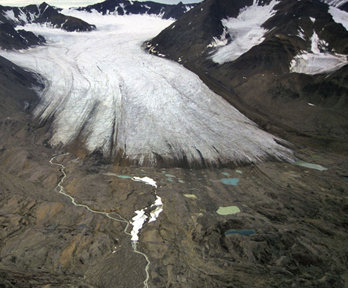
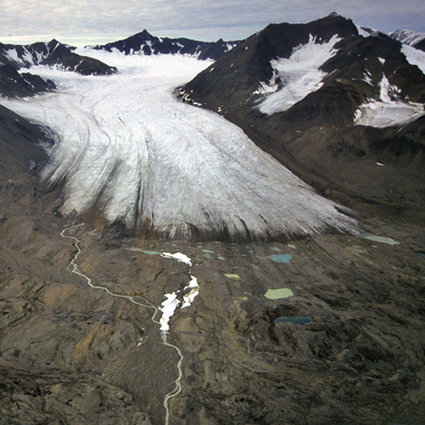
A large proportion of Arctic valley glaciers are called polythermal glaciers. These glaciers represent an intermediate thermal state with both cold and warm (or temperate) ice. Temperate ice is ice very close to the melting point (approximately 0°C). The processes that lead to a polythermal glacier are complex but can involve warming of ice through frictional heat from glacier motion, or through latent heat release from melting and refreezing as snow is compressed into glacier ice. Polythermal glaciers are usually drained by supraglacial (above) or englacial (within) meltwater channels. As heat is absorbed by the ice (particularly in the summer months) latent heat is released internally, and meltwater is created.
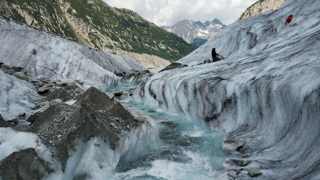
In lower latitudes, valley glaciers in alpine settings are more typically warm-based or temperate, although some may be polythermal. These warm-based alpine valley glaciers are the active glacial systems, typically in places with warm summer temperatures contrasting heavy winter snowfall. The high winter snowfall with rapid summer melt rates associated with alpine glaciers leads to high rates of winter-time ice mass accumulation in winter and summer-time ice mass melting. Due to meltwater acting as a lubricant at the glacier bed these glaciers are more mobile than cold glaciers. On average, observed alpine glaciers in the Alps lost more than 24m in thickness between 1997 and 2017. In 2018, annual alpine glacier mass loss was amongst the top ten since the 1960s.
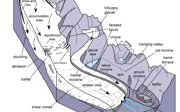
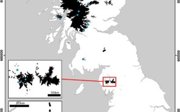
Alpine glaciers are self-contained environments at high altitude, which have a declining level of inputs over the winter period. These glaciers move down through valleys they erode and shape mountains, lakes and valleys. In Britain much of the landscape in England, Scotland and Wales has been influenced by glaciers, as recently as 12000 years ago as shown in Figure 6. They are also evident in the Alps.
Figure 6 shows regions in the UK where glaciers were active during the Loch Lomond Stadial (LLS) approximately 12,000 years ago. Ordnance Survey © Crown copyright and database 2015 extracted from The glacial geomorphology of the Loch Lomond (Younger Dryas) Stadial in Britain: a review