Long-term impacts
Meltwater
Figure 8 illustrates the concept of 'peak water' which predicts as temperatures continue to rise, there will be a temporary increase in runoff from glaciers in the Alps, as ice is lost from the mountain environment. Figure 8b shows increasing air temperature (on the y-axis) over time (on the x-axis). Initially, as temperature rises over a few decades, the ELA also rises, and glacier melt increases, resulting in greater runoff volumes (see Figure 8a). The maximum runoff volume is called peak water. Subsequent to this peak water runoff volume, further warming sees glaciers recede further, and their reduced area and volume provides less runoff. Runoff then declines until the glacier completely disappears.
Stream quality and Biodiversity
Receding glaciers leave moraines and easily eroded sediments in their proglacial area. As runoff increases toward peak water, glacier meltwater can entrain the sediments and increase the suspended load in the rivers flowing downstream.
The volume of glacier meltwater entering streams and rivers impacts on water temperature. Following peak water, as the volumes of cold glacier meltwater decreases, streams will warm up and their biodiversity changes.
As the ELA rises for glaciers in the Alps, the release of nutrients and biological matter downstream will increase. The rate of release of microbes and nutrients, which may have been frozen for hundreds of years, is increasing.
Human impact
The melting of glaciers in the Alps could have a profound long-term impact downstream across the 8 countries encompassed by the mountain range (for the country list see page 1). Impacts such as average winter runoff are expected to continue to rise, whilst summer runoff rates subside.
In the future increasing runoff rates are likely to overwhelm water management systems downstream (channels, culverts, drains, sewars, weirs, reservoirs and pumping stations) in lower altitude towns and cities. Hydroelectric power generation may become unreliable or unviable. Irrigation needs may not be met for farmers downstream.
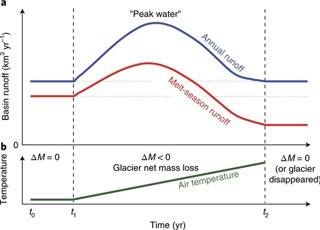
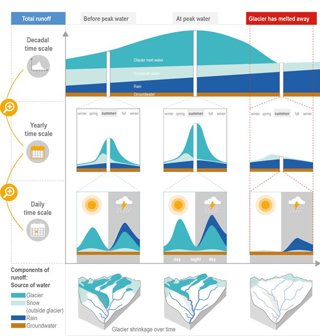
Figure 8 is part illustration, part graphic. To the left total runoff is presented by daily time scale, yearly, and decadal. In the top section, the graph illustrates how rain will increase whilst Glacial meltwater will decline after peak water.
Snowmelt will also decrease but at a slower rate, continuing beyond the lifespan of the glacier.
On the yearly timescale rain meltwater will always be at its highest just after summer, particularly in the period of peak water.
Glaciers will still be present then but are expected to be severely depleted and in retreat. The components of runoff will therefore transition from a mixture of glacier, snow and rain to only originating from a small amount of snow at high altitude.
Without a decisive response to climate change glacial melt will continue unabated in the Alps.
This will lead to a continued increase in ELA elevation, more bare ice, a further lowering of albedo, and an acceleration in the release of microbial life.
Scientists anticipate that sediment, microbes, organic matter, and nutrients in glacier runoff will impact on water quality and biodiversity for glacier fed rivers.