Salt marsh and coastal lagoons
Themes
Formation and biodiversity, ecosystem services, sea level rise, coastal flooding, urban and environmental sustainability
Example
Salt marsh restoration in the Venice Lagoon (Italy)
Unit aim
To gain an overview of salt marsh and coastal wetlands in general, their importance, and how they can be protected and restored.
Specific objectives
- To explain the processes of salt marsh formation in low energy coastal environments
- To understand their role in the global carbon cycle and other ecosystem services
- To learn about coastal lagoons in general and the Venice lagoon as a specific example
- To know about the reasons for salt marsh degradation and loss
- To explain restoration methods and stakeholder engagement
- To gain skills interpreting images and maps
- To show, with the example of Venice, how urban sustainability requires nature-based solutions, and how natural and human environments are interlinked
Learning activities and tasks
Introductory concepts
Students should start by studying the 'Salt marsh and coastal lagoons PPT' for the general overview. These slides include key concepts and definitions, such as intertidal zone, halophytes, plant succession, blue carbon, ecosystem services, etc., and examples of the main types of salt marsh plants. The slides also inform on the main threats facing salt marsh worldwide, including the problem of coastal squeeze.
The 'Further information on coastal wetlands DOC' includes webpage links and YouTube video links to find out more, and the 'Wetlands salt marsh key terms and definitions DOC' matching exercise can follow to consolidate learning as a review exercise or test.
Place-based example
The Venice Lagoon Action Site (part of the WaterLANDS Project in partnership with We are here Venice), provides the place-based example for learning about coastal lagoons, the importance of salt marsh and methods of protection and restoration.
Students should start by listening to the Interview with Jane da Mosto (founder of We are here Venice) which gives the overview on how the problems facing Venice and its lagoon are interlinked, the reasons for salt marsh restoration, and why public engagement through art and education is so important. This 4min30sec video Discover the Venice Lagoon, a WaterLANDS Action Site provides excellent visuals (in Italian with English subtitles).
The Interview with John Rapaglia part 1 goes into further detail on the hydrodynamics, sediment budget, and problems and challenges facing the Venice Lagoon, and the Interview with John Rapaglia part 2 details the restoration processes, solutions, and the work of WaterLANDS. John also discusses how he got involved in restoration work.
The 'Salt marsh restoration PPT' gives an image rich overview of the Venice Lagoon Action Site example that can be studied before or after listening to the interviews.
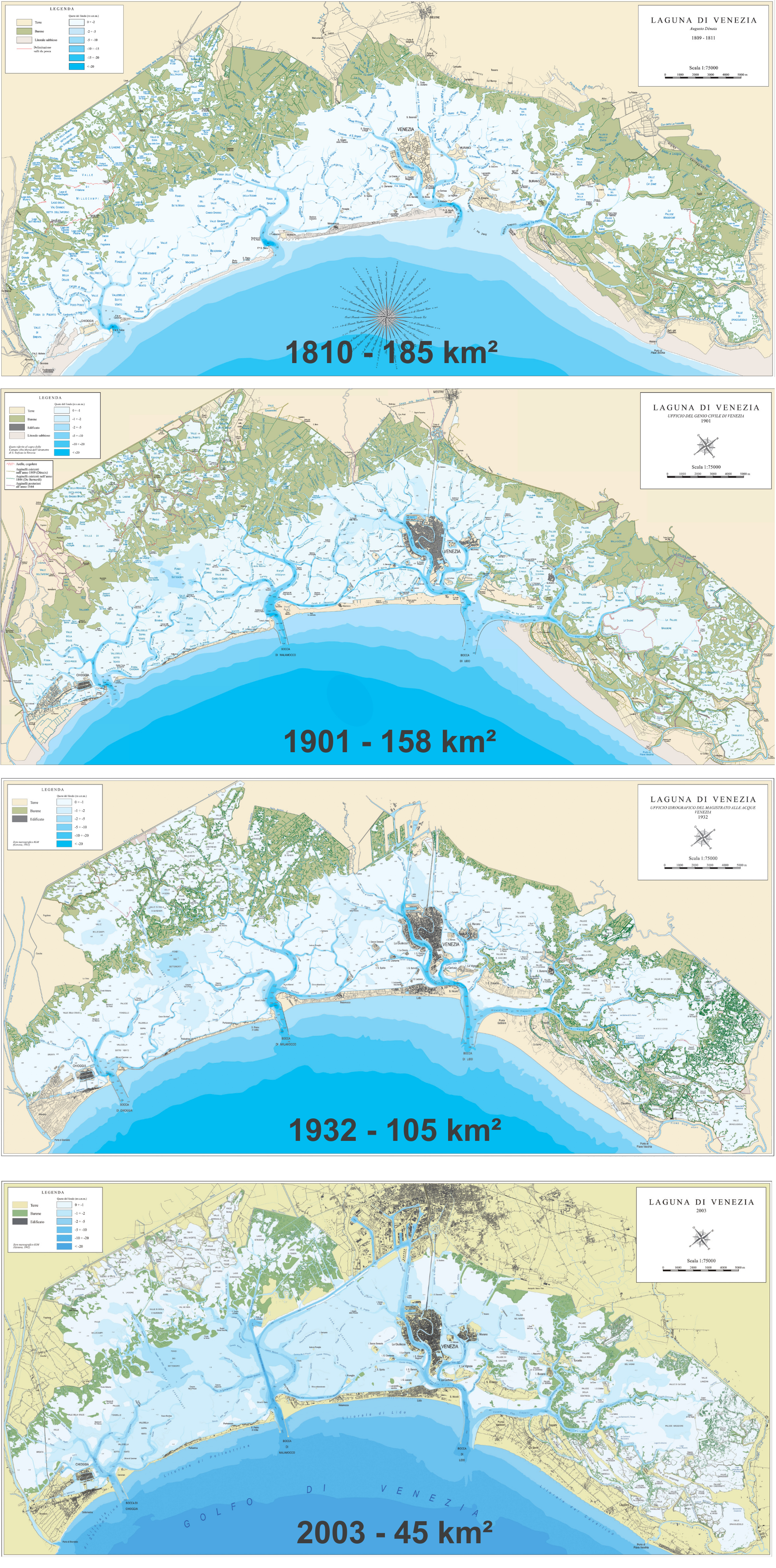
Students can do the 'Venice Lagoon map exercises DOC' (using Google Earth and some other maps) to learn about the physical and human geography of the Venice Lagoon area and about historic and recent human interventions and impacts (a separate document includes answers).
Some of the questions require students to study the historic maps of the lagoon in the 'HQ evoluzione nel tempo PNG'.
Review
Students can consolidate their understanding across the unit by attempting the short quiz and extended answer questions in the 'Review task on salt marsh and lagoons DOC'.
The extended answer questions can be used as prompts for class discussion and/or for a writing assignment (a separate document includes answers). The document also has past A Level exam questions that relate to this unit.
File nameFiles
File type
Size
Download