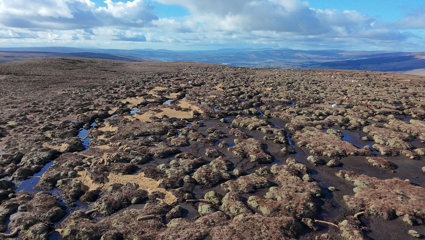
Terrestrial peatlands
Themes
Carbon storage, drainage basin hydrology and erosion, biodiversity, engagement with local farmers
Example
Blanket bog restoration in the Cuilcagh-Anierin Uplands Special Area of Conservation (Ireland)
Unit aim
To gain an overview of terrestrial peatlands, their importance, and how degraded peatlands can be restored.
Specific objectives
- To learn about peatlands and their unique biodiversity
- To explain how peatlands function as carbon sinks and how they influence local hydrology
- To know about the reasons for peatland degradation
- To explain various methods of peatland restoration
- To show how working with farmers and members of the local community is essential in achieving peatland restoration
- To gain skills interpreting images, maps, and data sets, and also a scoring method for ‘results based payment schemes’ (the scoring method concept could be applied in the context of the NEA independent investigation)
Learning activities and tasks
Introductory concepts
Students should start by studying the 'Peatlands facts and figures PPT' for the general overview on this type of terrestrial wetland. These slides include key definitions, such as blanket bog, carbon sink, water table, drainage basin, ecosystem services, etc., and examples of the main types of peat forming plants, e.g. Sphagnum species. Students can also study the 'Peatlands facts and figures hyperlinks DOC' to find out more. The 'Wetlands, hydrology and carbon cycle terms and definitions DOC' matching exercise can follow to consolidate learning as a review exercise or test.
Data on long-term carbon accumulation rates of peatlands in the Northern Hemisphere are contained in an Excel file (Peatland carbon accumulation data exercise XLS). The accompanying document 'Peatland carbon skills exercise DOC' contains tasks for students to work with the data and learn about the importance of peatlands as carbon sinks. This skills exercise also gives students the opportunity to use descriptive and inferential statistics (such as correlation) and to create charts in Excel.
Place-based example
The Cuilcagh-Anierin Uplands SAC, an Action Site within the WaterLANDS Project, provides the place-based example for learning about methods of peatland restoration. Students begin with the 'Cuilcagh-Anierin map exercise DOC' (using Google Maps and Google Earth) to locate and learn about the physical and human geography of the area.
Following familiarization with the area, students study the 'Peatland restoration PPT' slides. These show and explain examples of restoration methods at Cuilcagh-Anierin SAC to combat peatland erosion and to improve peatland hydrology and habitat.
Students can also listen to the interview with Guaduneth Chico (WaterLANDS Action Site Coordinator). The Interview with Guaduneth Chico of WaterLANDS begins with ten minutes on the Action Site, why it needs restoration, and how this is being done. In the second ten minutes of the interview, Guaduneth discusses his background in Geography and how it has supported his career and led to the work that he is doing now.
Students finish this unit by reading and completing the 'Peatland habitat score card task DOC'. This gives students an insight into how to assess the quality of peatland habitat and how to measure progress in an objective way. In the task, students work with a scoring system simplified from one that is used for the ‘results-based agri-environment payment scheme (RBPS)’ coordinated by LIFE IP Wild Atlantic Nature. Through this scheme, farmers have a financial incentive to implement restoration methods that improve their habitat score.
Review
Students can consolidate their understanding across the unit by attempting the short quiz and extended answer questions in the 'Review task on terrestrial peatlands DOC'. The extended answer questions can be used as prompts for class discussion and/or for a writing assignment.
In the podcast above, Caitriona Devery (UCD Earth Institute) talks with Guaduneth Chico about his role with WaterLANDS, why peatlands are important and methods of restoration. In the second half of the interview, Guaduneth discusses how Geography has shaped and supported his career.
File nameFiles
File type
Size
Download